Owner & Doctor of Chiropractic · 15 min read · Published · Updated · Last reviewed
Beaumont residents: Your accident was 3 days ago. You felt fine. Now your fingers won’t stop tingling — and you don’t know why.
You walked away from the collision on Interstate 10 or a busy local intersection feeling incredibly fortunate. You told the police, your insurance company, and your family that you were just a bit shaken up. But this morning, you woke up with a strange pins-and-needles sensation running down your arm, or a heavy, unmistakable numbness in your leg. It is scary, it is confusing, and it is one of the most common reasons people in our community search for answers online.
Experiencing numbness tingling after car accident Beaumont TX nerve damage is a direct warning sign from your body — especially when it appears days after the crash. It is a signal that something beneath the surface was not nearly as “fine” as you originally thought.
In this guide, we walk you through exactly what is happening in your nervous system, why symptoms take a few days to appear, and precisely what you need to do next to protect your health and your future.
Why numbness tingling after car accident Beaumont TX nerve damage appears days later — not immediately
When you are involved in an auto collision, the immense physical force of the crash triggers an immediate biological reaction. Your body instantly goes into “fight or flight” survival mode, flooding your system with adrenaline, cortisol, and endorphins. This natural, evolutionary response acts as a temporary painkiller. It masks the immediate trauma of the impact, allowing you to speak to the police and safely get home.
However, as that adrenaline wears off over the next 24 to 72 hours, your body’s inflammatory response kicks into high gear. When muscles, tendons, and ligaments sustain microscopic tears from the sudden jolt of a crash, the body sends fluid and white blood cells to the area to begin the healing process. This causes localized swelling.
When this swelling occurs near your spinal column or major joint pathways, the excess fluid begins to press against your delicate nerves. This delayed compression is precisely why you felt completely “okay” on Tuesday but are waking up with a dead-feeling arm or tingling fingertips on Friday. Delayed pain or altered sensations are normal biological responses to auto trauma — but they are absolutely not something you should ignore.
What your body is telling you — 4 injuries that cause post-accident nerve symptoms
Nerve symptoms — pins and needles, a burning sensation, sudden weakness, or a loss of feeling — act as your body’s internal check-engine light. They indicate exactly where a structural issue is occurring. By paying attention to where the tingling travels, specialists can often trace the problem back to its source.
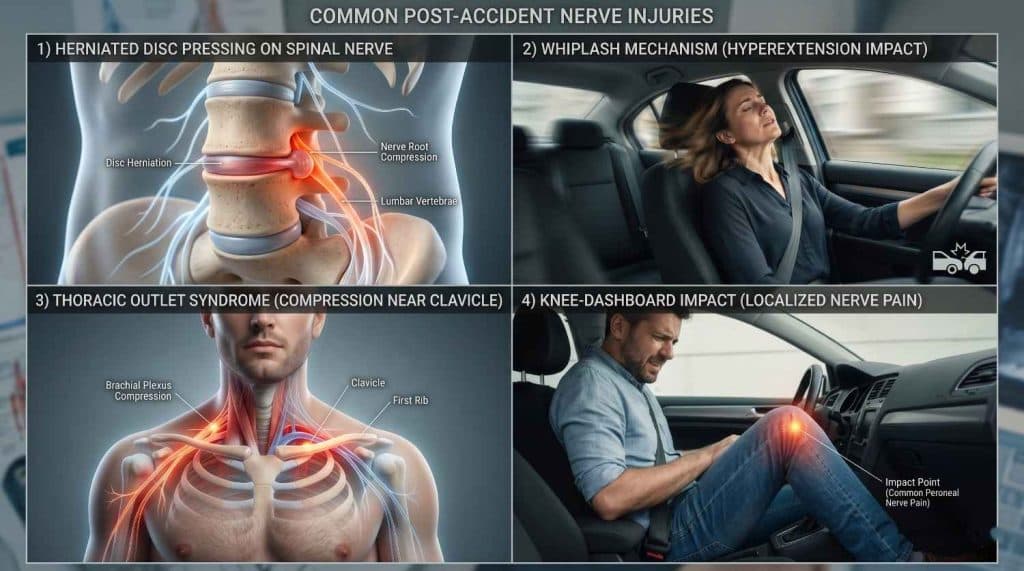
Here are the four most common injuries that lead to these post-accident nerve symptoms:
1. Herniated Discs
The abrupt impact of a vehicle collision can force the soft, jelly-like center of your spinal discs out of alignment and through the tough exterior casing. When this happens, you likely have aherniated disc pressing on spinal nerves. This compression acts like a kink in a garden hose. If the herniation occurs in your lower back (lumbar spine), it will produce numbness, tingling, and weakness running down your legs and into your feet. If it occurs in your neck (cervical spine), you will feel those symptoms radiating down your arms and hands.
2. Whiplash and Cervical Trauma
We often think of whiplash as simply a stiff or sore neck. However, the rapid back-and-forth snapping motion of the head does far more than strain muscles. It can cause severe whiplash-related nerve stretching in the cervical spine. This stretching, combined with subsequent inflammation in the neck, disrupts the nerve signals traveling from your spinal cord to your upper extremities — leaving you with an inability to grip objects properly or persistent tingling in your fingertips.
3. Thoracic Outlet Syndrome (TOS)
The thoracic outlet is the narrow space between your collarbone and your first rib. During a crash, the forceful restraint of a seatbelt across your chest and shoulder can compress the cluster of blood vessels and nerves passing through this area. If you are experiencing dull shoulder pain accompanied by numbness radiating down your arm and into your hands — especially if your hands feel uncharacteristically cold — Thoracic Outlet Syndrome is a likely culprit.
4. Direct Nerve Contusions
Sometimes nerve damage does not originate from the spine, but from a direct, blunt-force impact. Striking your knee against the dashboard or slamming your elbow against the door panel can physically bruise the nerve itself — a condition known as a nerve contusion. Peripheral nerve trauma causes localized numbness at the site of impact that radiates outward, often accompanied by a deep, aching pain.
The dangerous mistake Beaumont accident victims make when they feel tingling
When faced with alarming new symptoms, the most natural reaction is to hope they fade away on their own. You might tell yourself, “I’ll rest this weekend, take some ibuprofen, and see how I feel on Monday.” In the context of an auto collision, this “wait and see” approach is one of the most damaging decisions you can make.
First, consider your physical health. Your nerves are delicate structures. When a nerve is compressed, pinched, or stretched, it is being starved of proper blood flow and signal transmission. If that pressure is not relieved promptly, temporary numbness can transform into chronic pain. In severe cases, nerve damage that goes untreated for weeks can become permanent, altering your mobility and quality of life long-term.
Second, consider your insurance claim. Auto insurance companies closely monitor your actions following a crash. If you delay seeking professional medical attention, adjusters will use that “treatment gap” against you. They will argue that your injuries must not have been serious, or claim that your nerve damage was caused by a separate incident after the accident. Every day you go without an official medical evaluation, you weaken both your health and your financial standing by lackingproper medical documentation.
How Car Accident Cares diagnoses nerve damage — without guessing
When you are dealing with potential nerve damage, there is no room for guesswork. At Car Accident Cares, we use a precise, evidence-based approach to uncover the exact root cause of your numbness and tingling so we can treat it correctly the first time.
Your visit begins with a comprehensive neurological and physical examination. Our specialists will test your reflexes, assess your muscle strength, and map your sensory responses to pinpoint exactly which nerve pathways are being affected. We never stop at just a physical exam.
To see what is happening beneath the surface, we rely on advanced diagnostic services. We provideaffordable MRI diagnostic imaging to accurately identify hidden soft tissue damage, bulging discs, and nerve impingements that standard ER X-rays simply cannot detect. Once we have a confirmed diagnosis, we match you directly with the right specialist for your specific injury. You will not have to navigate the healthcare system alone or wait weeks for referrals. We also offer same-day evaluations so you are never left anxiously wondering what your symptoms mean.
What treatment looks like for post-accident nerve symptoms in Beaumont
Hearing the words “nerve damage” can be frightening, but the vast majority of post-accident nerve issues can be resolved with conservative, non-surgical treatments. At our clinic, we treat the root cause of your pain rather than masking symptoms with prescription medications.
Your personalized recovery plan will typically begin with targetedchiropractic spinal decompression. This technique creates negative pressure within the spinal discs, actively relieving the pressure on pinched nerves. This is frequently paired withstructured physical therapy to rebuild the supporting muscles in your neck and back, improve flexibility, and reduce localized inflammation. Research shows that multimodal care — combining manual therapy with targeted exercise — produces significantly better outcomes for patients with nerve compression injuries compared to rest alone.
If your nerve pain is particularly acute and preventing participation in physical therapy, our pain management consultants may use targeted interventions likenerve block injections. These provide localized relief, giving your body the breathing room it needs to heal naturally.
Our primary goal is always to heal your body using non-invasive methods first. However, if your diagnostic imaging reveals that injuries require surgical correction, we have orthopedic and spine surgeon consultations available directly within our network. Because our team collaborates closely under one unified network, your care is seamless and entirely focused on getting you back to your normal life.
Book your same-day nerve damage evaluation at Car Accident Cares
You do not have to live with the fear and uncertainty of waking up with numbness, weakness, or tingling. Our team is committed to providing compassionate, evidence-based medical care without adding stress to your life during this difficult time.
We have removed the common barriers to getting help. Concerned about getting to the clinic while you are in pain? We offer a convenient transportation facility to ensure you can reach us safely. Worried about the financial logistics? There is no upfront cost barrier, and our administrative team handles all communication and paperwork directly with your auto insurance providers. Your only job when you walk through our doors is to focus on your recovery.
Protect your health, secure your peace of mind, and safeguard your future. Do not let a symptom you are ignoring today become a permanent problem tomorrow. Reach out to our team to book your same-day evaluation and get started.
Conclusion
Waking up with numbness or tingling days after a Beaumont car accident is your body’s way of signaling that professional evaluation is needed. Whether those sensations are caused by a herniated disc, whiplash, or thoracic outlet syndrome, these injuries will not resolve on their own with rest. Waiting risks transforming a treatable condition into permanent nerve damage — and hands insurance companies the exact excuse they need to question your claim.
Nerve recovery is largely time-dependent. Published clinical findings confirm that the sooner nerve compression is identified and treated, the better the long-term functional outcome. A delay of even two to three weeks can meaningfully reduce how fully a nerve heals. Early, targeted intervention is not just about pain relief today — it is about protecting your mobility and independence for years to come.
AtCar Accident Cares, our multidisciplinary team is ready to identify the root cause of your symptoms and build a personalized, conservative treatment plan. With same-day evaluations and an administrative team that handles insurance paperwork, getting the care you deserve has never been more straightforward. Reach out today to explore our full range of injury recovery services and get back to feeling like yourself again.
Frequently Asked Questions About Car Accident Care in Beaumont
Why didn't I feel the numbness immediately after my car accident?+
In the immediate aftermath of a crash, your body is flooded with adrenaline and endorphins, which act as natural painkillers. It typically takes24 to 72 hours for this adrenaline to wear off and for localized inflammation to peak. As swelling increases around your spine or joints, it begins to compress your nerves — which is why numbness and tingling appear days later.
Will the tingling in my fingers or toes just go away on its own?+
It is unlikely if a structural issue is present. Tingling, burning, or numbness are direct signs of nerve compression or damage. If the underlying cause — such as a bulging disc or spinal misalignment — is not corrected, the pressure on the nerve will remain. Leaving it untreated can lead to chronic or permanent nerve damage.
What kind of doctor should I see for nerve pain after a Beaumont car accident?+
You need specialists with dedicated experience in auto-trauma recovery. Traditional ERs are appropriate for life-saving stabilization, but for ongoing nerve compression, you need a targeted approach. Our clinic provides access to auto injury chiropractors, physical therapists, and pain management specialists who collaborate to treat the root cause of your nerve symptoms.
Will I need spine surgery if I have nerve damage from my accident?+
Not necessarily. The vast majority of post-accident nerve compression issues respond well to non-surgical, conservative methods. Techniques like chiropractic spinal decompression, targeted physical therapy, and non-narcotic nerve block injections are our first line of defense. Surgery is only considered when diagnostic imaging shows severe damage that does not respond to conservative care.
How quickly can I get an appointment if I wake up with a numb arm or leg?+
We understand how alarming sudden numbness can be, which is why we offer same-day evaluations at our Beaumont clinic. We want to get you accurately diagnosed — using advanced MRI imaging if necessary — so you can begin a tailored recovery plan without spending another day in pain or uncertainty.
How does transportation assistance work for my appointment?+
We understand that driving might be painful or impossible if you are dealing with severe nerve symptoms, weakness, or a damaged vehicle. Car Accident Cares offers a complimentary, convenient transportation facility for our Beaumont patients. When you call to book your same-day evaluation, simply mention that you need a ride, and our administrative team will coordinate safe transportation to and from our clinic at no upfront cost to you.
What are the common warning signs of nerve damage after an auto collision?+
Nerve symptoms act as your body’s internal check-engine light. Common signs include a “pins and needles” sensation, a persistent burning feeling, sudden muscle weakness, or a complete loss of feeling in your arms, legs, hands, or feet.
Can a herniated disc from a car accident cause leg numbness?+
Yes. If the impact of a crash causes a herniated disc in your lower back (lumbar spine), it can press against your spinal nerves. This compression can produce numbness, tingling, and weakness that radiates down your legs and into your feet.
How is nerve damage accurately diagnosed?+
Accurate diagnosis requires going beyond a standard physical exam. It typically involves a comprehensive neurological assessment to test reflexes, muscle strength, and sensory responses, followed by advanced MRI diagnostic imaging. MRIs can detect hidden soft tissue damage, bulging discs, and nerve impingements that traditional X-rays miss.
Will delaying treatment for numbness affect my auto insurance claim?+
Yes. Auto insurance companies closely monitor how quickly you seek care after a crash. Delaying treatment creates a “treatment gap” that adjusters may use to argue your injuries were not serious or occurred after the accident. Seeking immediate medical evaluation provides the official documentation needed to protect both your health and your financial standing.
Medically reviewed by
Verified
DS
Deepak Sharma
DC
Owner & Doctor of Chiropractic
Deepak Sharma, DC is a licensed Doctor of Chiropractic and the owner of Car Accident Cares in Beaumont, TX. He reviews the clinical content published across the site and works with a multidisciplinary network of MDs, chiropractors, imaging centers, and pain-management specialists focused on accurate diagnosis, evidence-based treatment, and complete recovery for motor-vehicle-accident victims across Beaumont and Houston.