
Orthopedic and Spine Surgeon Consultation in Beaumont, TX
An orthopedic or spine surgeon consultation is a specialist evaluation that is recommended when an accident injury involves a suspected fracture, persistent severe pain, neurologic symptoms, a herniated disc, or joint instability that has not responded to conservative care. The visit itself does not commit you to surgery — most consultations end with a non-surgical-first plan. The point is to have the right specialist look at the right injury before things get worse.
Medically reviewed by Deepak Sharma, DC · Last reviewed · Updated
Quick answer · Key facts
- Orthopedic surgeons are board-certified physicians (MD or DO) trained in injuries of the bones, joints, ligaments, tendons, and spine.
- Most accident-related ortho consultations result in non-surgical treatment — bracing, injections, therapy, and time — not an operation.
- Surgery is typically reserved for fractures, instability, severe nerve compression, or persistent disability after a documented course of conservative care.
- The American Academy of Orthopaedic Surgeons (AAOS) endorses shared decision-making: the patient and surgeon decide together.
- We coordinate the consultation, imaging, and any post-op or non-surgical follow-up under one care team.
- Medically reviewed by Deepak Sharma, DC.
What is an orthopedic or spine surgeon consultation?
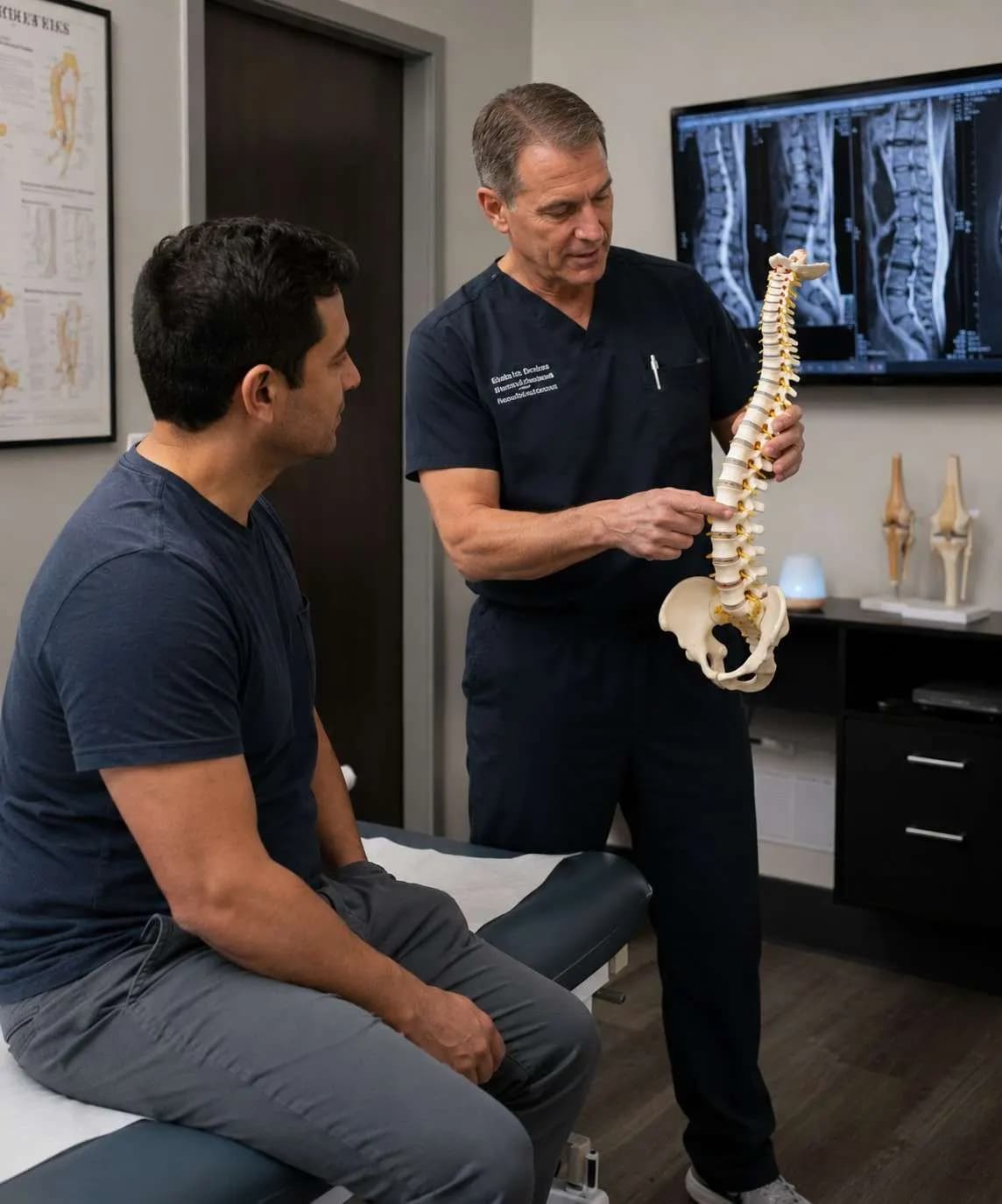
An orthopedic consultation is an evaluation by a physician who specializes in the musculoskeletal system — bones, joints, ligaments, tendons, muscles, and the spine. A spine surgeon is an orthopedic surgeon or neurosurgeon with additional fellowship training in cervical, thoracic, and lumbar spine conditions.
The visit usually combines a focused history, a hands-on exam, review of your imaging (X-ray, CT, MRI), and a discussion of options. As the NIH MedlinePlus resource emphasizes, the goal is to match the right treatment to the right injury — which is most often non-surgical.
A surgeon's most important tool is judgment about when not to operate.
When is an ortho or spine consult recommended after a crash?
Not every accident injury needs a surgeon. A specialist consultation is usually warranted when one of the following is true:
- Suspected or confirmed fracture, especially with displacement, instability, or joint involvement
- Severe or progressive neurologic symptoms — numbness, weakness, or radiating pain down a limb
- Herniated disc with persistent nerve symptoms despite four to six weeks of conservative care
- Persistent severe pain that limits work, sleep, or daily function after initial treatment
- Joint instability, recurrent dislocation, or a torn ligament suggested on imaging
- Any sign of spinal cord involvement (gait change, bowel or bladder symptoms) — urgent evaluation
- Failed conservative care after a documented course of therapy, medication, and time
What does the consultation include?
A first visit is built around getting the diagnosis right and explaining your options in plain language. Here is the typical sequence:
- 1
History & accident review
How the crash happened, your symptoms, prior injuries, work demands, and what care you have already received. - 2
Focused exam
Inspection, palpation, range of motion, joint stability testing, strength, reflexes, and neurologic screening. - 3
Imaging review
X-ray, MRI, and CT are reviewed together. The surgeon may order additional views, an EMG/nerve study, or a more targeted MRI. - 4
Diagnosis & options
You receive a clear explanation of the injury and the realistic options — bracing, therapy, injections, watchful waiting, or in selected cases surgery. - 5
Shared decision-making
Risks, benefits, and timelines are reviewed together. Most patients leave with a non-surgical plan and a defined re-evaluation point. - 6
Coordinated follow-through
Therapy, injections, repeat imaging, or pre-surgical planning are scheduled and tracked across the team.
Non-surgical-first — and what surgery actually involves when it is needed
Bracing & immobilization
For selected fractures, sprains, and some cervical injuries to allow tissue healing.
Physical therapy
Progressive stretching, strengthening, and movement re-education is the backbone of most recovery plans.
Injections
Epidural steroid injections, facet injections, or joint injections to reduce inflammation and confirm the pain generator.
Microdiscectomy
When nerve compression from a herniated lumbar or cervical disc does not improve, removing the offending fragment can relieve symptoms.
Cervical or lumbar fusion
Reserved for instability, severe stenosis, or refractory radiculopathy when other care has not worked.
Fracture fixation
Open reduction and internal fixation when bones are displaced, unstable, or involve a joint surface.
Insurance, PIP, and lien arrangements for ortho care
Orthopedic and spine consultations are typically covered by health insurance and by Texas PIP or MedPay auto coverage when the visit is related to a crash. We verify benefits before your appointment.
For patients without coverage or waiting on a settlement, we coordinate with personal-injury attorneys on lien-friendly billing so a needed specialist visit is not delayed. Cost and options are explained before the consult, including any imaging, injections, or surgical planning the surgeon recommends.
Why waiting too long can change your options
Some accident injuries — displaced fractures, severe nerve compression, unstable joints — have a narrow window for the best outcome. Others can be managed conservatively as long as progress is real and measurable.
The risk of waiting is not seeing a surgeon at all — it is waiting too long without a plan. If symptoms are severe, neurologic, or unimproved after several weeks of care, an ortho or spine consult is the next step rather than another round of the same therapy.
Why patients choose our orthopedic consultation pathway
We are not a surgical mill. We exist to get the right answer for the right patient and to coordinate care across the team.
Non-surgical-first philosophy
Specialist + multidisciplinary team
Fast access to specialist visits
Shared decision-making
Documentation that supports your claim
Lien-friendly billing
Hear From Our Satisfied Clients
“I was sure I needed surgery for my back. The surgeon actually talked me out of it — said the MRI looked manageable and laid out a non-surgical plan. Six weeks later, I was back at work.”

“My arm was getting weaker and the pain was constant. They got me in to see a spine surgeon within days, found a herniated disc pressing a nerve, and walked me through every option before we decided together.”

Other ways we help recovery
Chiropractor Care in Beaumont
Spinal alignment, soft-tissue manipulation, and adjustment therapies to relieve back and neck pain after a collision.
Learn moreMD Consultation in Beaumont
Initial medical evaluation by a licensed primary-care MD to document injuries and coordinate downstream care.
Learn moreBest Affordable Beaumont MRI Diagnostic Imaging Service
High-field MRI for soft-tissue, disc, and ligament injuries — same-week appointments and transparent pricing.
Learn morePain Management Consultants in Beaumont
Non-surgical interventional pain specialists — trigger-point, epidural, facet joint, and medication management.
Learn moreCommon injuries we treat
Whiplash & Neck Pain Treatment
The #1 injury seen after rear-end collisions — even at low speeds.
See protocolHerniated Disc Doctor
Sciatica, radiating pain, and weakness from disc injuries.
See protocolLower Back & Knee Pain Treatment
Lumbar strain, ligament damage, and post-collision joint pain.
See protocolShoulder Injuries
Rotator cuff, labral tears, and seatbelt-related shoulder trauma.
See protocolFrequently Asked Questions About Orthopedic and Spine Surgeon Consultation
Don't see your question? Call us at (409) 834-4100 — we answer 24/7.
Does seeing an orthopedic surgeon mean I will need surgery?
No. The majority of consultations after a car accident end with a non-surgical plan — bracing, therapy, injections, and time. The visit exists to make sure the right diagnosis and the right treatment are in place, not to push surgery.When should I ask for an orthopedic or spine consultation?
Reasonable triggers include a suspected fracture, severe pain that is not improving, numbness or weakness in a limb, radiating pain down an arm or leg, joint instability, or symptoms that have not improved after four to six weeks of appropriate care. Any spinal cord symptom — gait change, bowel or bladder issues — is urgent.What is the difference between an orthopedic surgeon and a spine surgeon?
Orthopedic surgeons train in the entire musculoskeletal system. Spine surgeons are orthopedic surgeons or neurosurgeons with additional fellowship training focused on the cervical, thoracic, and lumbar spine. For complex spinal injuries, a fellowship-trained spine surgeon may be the right specialist.What should I bring to the consultation?
A list of symptoms, your medications, prior surgeries, the date of the crash, any imaging you have had (X-ray, MRI, CT), records from the ER or other providers, your insurance information, and contact information for your attorney if you have one.Will I get my MRI or X-ray results explained at the visit?
Yes. The surgeon reviews your imaging with you, points to the findings, and ties them to your symptoms and exam. If additional or higher-quality imaging is needed, that is arranged at the same visit.When is surgery actually recommended after a car accident?
Most often for unstable or displaced fractures, severe nerve compression that is not improving with conservative care, joint instability that prevents normal use, or specific spinal injuries that risk permanent damage if left untreated. The decision is shared between you and the surgeon.What is recovery and return to work like after spine surgery?
It depends entirely on the procedure. A microdiscectomy is typically a same-day operation with a return to light work in a few weeks. A fusion is more involved, with restrictions for several months. Your surgeon will walk through a realistic timeline for your specific situation.Can I get a second opinion?
Absolutely — and you should, especially before any elective surgery. The AAOS supports shared decision-making and second opinions. We are happy to send your records and imaging to a second surgeon.Does insurance or PIP cover the consultation?
Health insurance and Texas PIP or MedPay coverage typically apply when the visit is related to a crash. We verify benefits before the appointment. For patients without coverage, we can coordinate lien-friendly billing through your attorney.How quickly can I be seen?
Accident patients with severe or neurologic symptoms are prioritized. For most consultations we are able to schedule within the same week — sooner if the situation is urgent.
Deepak Sharma, DC is a licensed Doctor of Chiropractic and the owner of Car Accident Cares in Beaumont, TX. He reviews the clinical content published across the site and works with a multidisciplinary network of MDs, chiropractors, imaging centers, and pain-management specialists focused on accurate diagnosis, evidence-based treatment, and complete recovery for motor-vehicle-accident victims across Beaumont and Houston.
Explore Blog

What to Expect from Your Whiplash Recovery Timeline Texas After a Car Accident
Most whiplash patients recover within 6 to 12 weeks with appropriate care — but that window is not guaranteed, and for Beaumont drivers dealing with delayed sy…

Can a Car Accident Aggravate a Pre-Existing Condition in Texas?
If you have been involved in a motor vehicle collision in Southeast Texas, you likely have countless questions running through your mind. Assessing vehicle dam…
Understanding Different Types of Car Accident Impacts and Injuries
Driving through busy Beaumont TX—especially near intersections on Dowlen Road, along Interstate 10, or through the heavy traffic on College Street—means dealin…
Find Auto Injury Specialist Near You
Same-week appointments. Lien-friendly billing. Over 100 clinic locations across Beaumont and Houston.