
Comprehensive Herniated Disc Treatment After Car Accidents in Beaumont TX
A herniated disc happens when the soft, jelly-like center of a spinal disc pushes through a tear in its tougher outer ring and presses on nearby nerves — a common consequence of the sudden forces in a motor-vehicle collision. After a Beaumont crash, the hallmark signs are neck or back pain with radiating pain, numbness, weakness, or tingling down an arm or leg. Most herniated discs improve with conservative care over weeks to a few months; surgery is reserved for cases that fail conservative treatment or involve progressive neurological deficits.
Medically reviewed by Deepak Sharma, DC · Last reviewed · Updated
Quick answer · Key facts
- A herniated disc occurs when the nucleus pulposus pushes through a tear in the annulus fibrosus, often irritating a nearby nerve root.
- Lumbar (lower back) and cervical (neck) discs are most often affected after a car accident.
- Typical symptoms include radiating limb pain (sciatica or cervical radiculopathy), numbness, tingling, or weakness — sometimes more prominent than the back or neck pain itself.
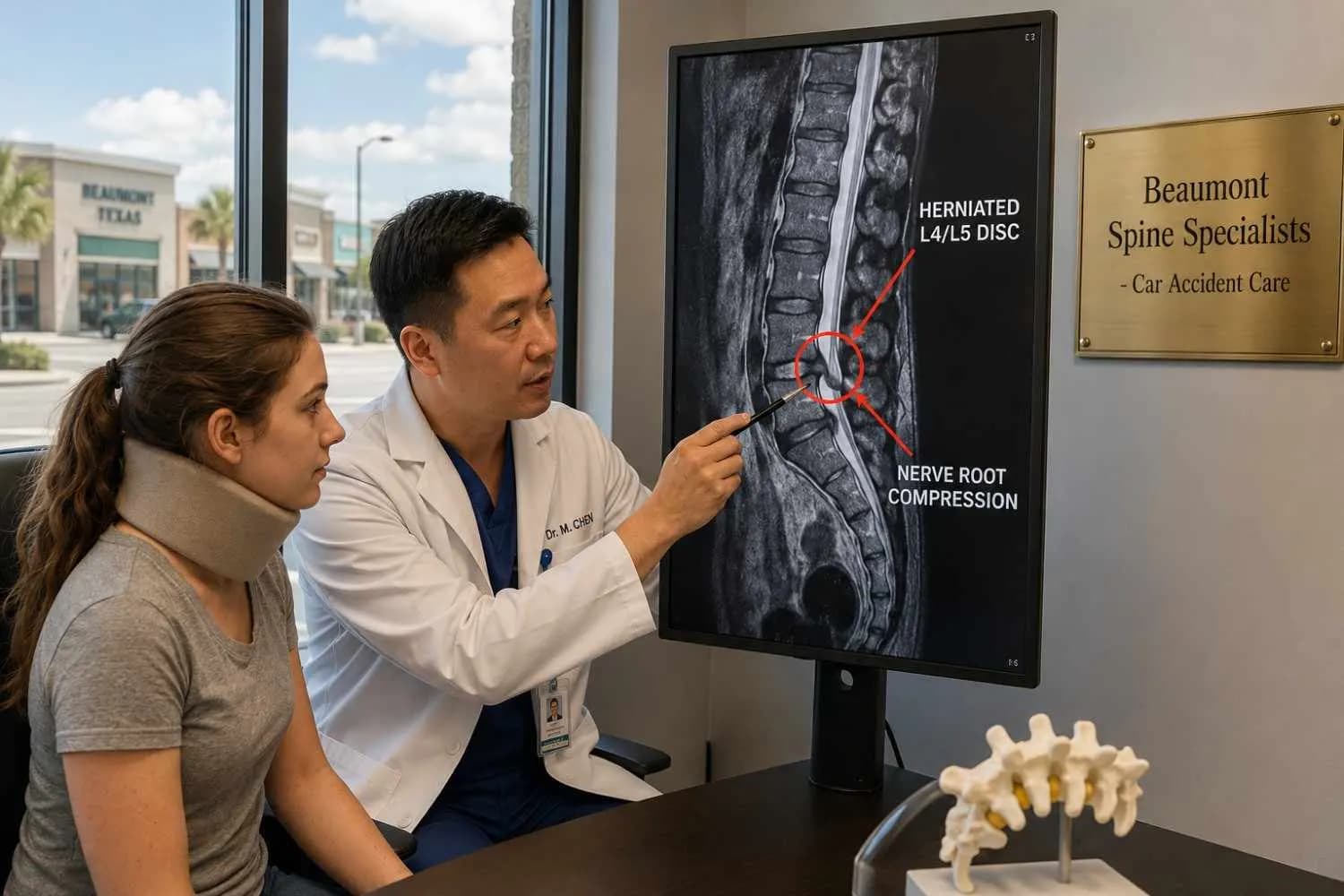
- MRI is the imaging study of choice for confirming a herniated disc and identifying nerve compression.
- Most patients improve with non-surgical care; surgery is considered for progressive weakness, intractable pain, or cauda equina syndrome.
- Medically reviewed by Deepak Sharma, DC.
What is a herniated disc, and how does a car accident cause one?
Between each pair of vertebrae sits a spinal disc — a small shock absorber with a tough outer ring (the annulus fibrosus) and a softer gel-like center (the nucleus pulposus). When the annulus tears or weakens, the nucleus can bulge or push through and press on a spinal nerve root or, less often, on the spinal cord itself.
In a crash, the sudden flexion, extension, and compressive forces on the spine — especially from rear-end and side impacts — can be enough to tear the annulus or accelerate the failure of a disc that was already worn. According to the American Association of Neurological Surgeons (AANS), herniated discs occur most often in the lumbar and cervical spine.
The pain you feel in your leg or arm often is not the leg or arm at all — it is a nerve in your spine telling you it is being pinched.
Cervical vs. lumbar herniation: what symptoms should you watch for?
Radiating arm pain
Cervical herniation can cause sharp or burning pain that travels from the neck into the shoulder, arm, or hand.
Hand numbness or tingling
Paresthesias in specific fingers may map to a particular cervical nerve root.
Arm or grip weakness
Difficulty lifting, gripping, or using fine motor control on one side.
Sciatica
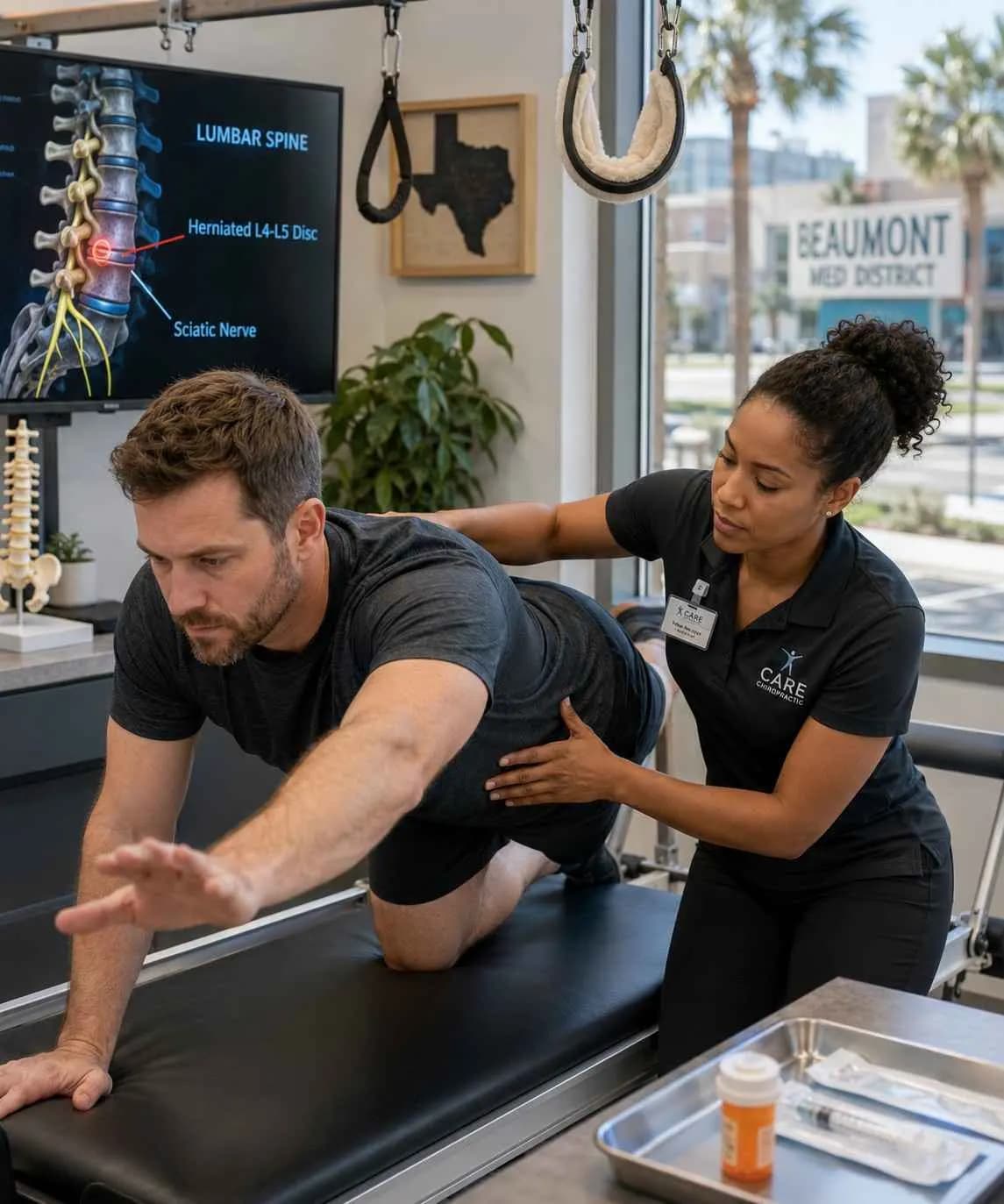
Lumbar herniation can cause pain shooting from the lower back through the buttock and down the leg.
Leg numbness or weakness
A foot drop or trouble pushing off the toes may signal a specific nerve root.
Pain worse with sitting, coughing, sneezing
Activities that raise pressure in the disc often worsen radicular pain.
When is a herniated disc an emergency? Red flags you should not ignore
Most herniated discs are not emergencies — but a small number are. Cauda equina syndrome is a rare but urgent complication of a large lumbar herniation that compresses the bundle of nerves at the base of the spinal cord. It requires immediate evaluation, typically with emergency surgery, to protect bowel, bladder, and leg function.
If you experience any of the following after an accident, call 911 or go to the nearest emergency department:
- New loss of bladder or bowel control, or difficulty starting urination
- Numbness in the inner thighs, groin, or buttocks ("saddle anesthesia")
- Rapidly worsening or severe weakness in one or both legs
- Loss of sensation that is spreading or progressing
- Sudden, severe neck or back pain with fever, chills, or unexplained weight loss
- Any new difficulty walking or maintaining balance after a crash
Short of these red flags, ongoing radiating pain, numbness, or weakness still deserves a prompt clinical evaluation — early diagnosis tends to make conservative treatment more effective and helps document the link between your symptoms and the accident.
How is a herniated disc diagnosed after a crash?
Diagnosis is a clinical decision supported by imaging. Our team follows a careful sequence designed to confirm the source of your symptoms without unnecessary tests.
- 1
History and symptom mapping
We ask about the accident, the pattern of pain, what makes it better or worse, and any numbness or weakness so we can predict which nerve root is involved. - 2
Neurological exam
Strength testing, sensation, and reflexes help localize the level of the herniation and rule out emergencies like cauda equina syndrome. - 3
Conservative trial and reassessment
For most patients without red flags, an initial period of conservative care comes first, with close follow-up to track progress. - 4
MRI when indicated
If symptoms are severe, persistent, or progressive, MRI — the imaging of choice per the North American Spine Society (NASS) — confirms the herniation and shows nerve compression. - 5
Specialist referral when needed
If conservative care fails or a deficit progresses, we coordinate referral to a spine surgeon to discuss further options.
What does treatment look like? Conservative-first care
Major guidelines from the NIH MedlinePlus and the North American Spine Society emphasize a conservative-first approach. The majority of herniated discs improve over weeks to a few months without surgery.
A typical care plan may include short-term NSAIDs or other analgesics, activity modification (not strict bed rest), guided physical therapy focused on core strengthening and movement, and, in selected cases, an epidural steroid injection to calm nerve-root inflammation. Chiropractic care, when integrated with medical oversight, can also support recovery for appropriate patients.
Surgery — typically a microdiscectomy for lumbar disease or an anterior cervical procedure for cervical disease — is generally considered when conservative care fails after a reasonable trial, when pain is intractable, or when there is progressive neurological deficit or cauda equina syndrome.
Herniated disc care: cost, insurance & attorney liens in Beaumont
The cost of evaluating and treating a herniated disc depends on the imaging and treatments involved, and your coverage depends on your specific plan. We coordinate directly with health insurers and personal-injury attorneys so you can focus on recovery rather than paperwork.
If you do not have health insurance or are waiting on a settlement, ask about our lien-friendly arrangements: you can be evaluated, imaged, and treated now, with payment deferred and resolved through your accident claim. We will explain your options clearly before care begins.
Why timing matters with a herniated disc
Two clocks start the moment of a crash — one medical, one legal. Medically, a nerve root that has been compressed and inflamed for weeks tends to be harder to settle than one treated early; ongoing weakness, in particular, deserves prompt attention.
For your claim, a documented gap between the accident and your first evaluation can be used by an insurer to question whether the crash caused your injury at all. An early, dated record links your symptoms to the collision and protects both your recovery and your case.
Why choose Car Accident Cares for herniated disc treatment
From the first exam to imaging and care planning, we build every step of herniated disc treatment around accident recovery — clinical, coordinated, and documented.
Physician-led, conservative-first care
On-site MRI access
Integrated PT, medical, and chiropractic
Clear surgical pathway when needed
Lien-friendly billing
Documentation that holds up
The goal is not just to make pain go away — it is to protect the nerve, restore function, and document what happened so nothing about your case is left to guesswork.
Hear From Our Satisfied Clients
“I thought I just had a stiff neck after the wreck, but my fingers kept going numb. They got me an MRI the same week and found a herniated disc — within a few weeks of PT and care I finally had my hand back.”
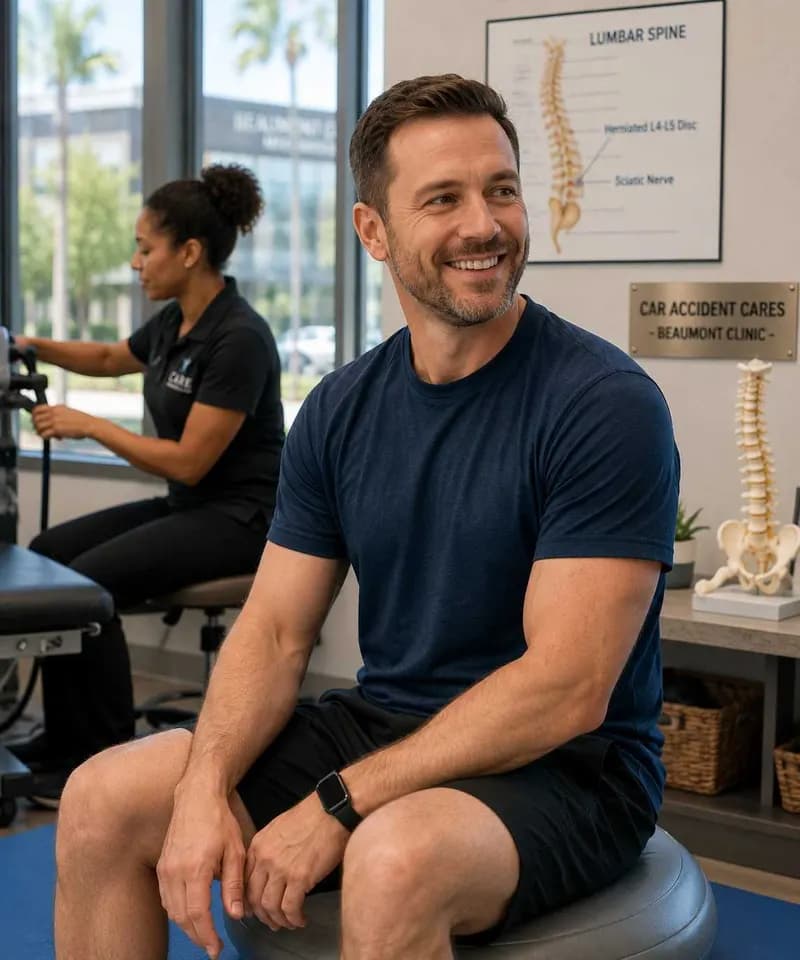
“Sciatica down my leg was so bad I could barely sit. They walked me through every step, started with conservative care, and when I needed an injection they coordinated it. No surgery — and I'm finally back to work.”

Services we use to treat this injury
Chiropractor Care in Beaumont
Spinal alignment, soft-tissue manipulation, and adjustment therapies to relieve back and neck pain after a collision.
Learn moreMD Consultation in Beaumont
Initial medical evaluation by a licensed primary-care MD to document injuries and coordinate downstream care.
Learn moreBest Affordable Beaumont MRI Diagnostic Imaging Service
High-field MRI for soft-tissue, disc, and ligament injuries — same-week appointments and transparent pricing.
Learn morePain Management Consultants in Beaumont
Non-surgical interventional pain specialists — trigger-point, epidural, facet joint, and medication management.
Learn moreOther injuries patients often have together
Whiplash & Neck Pain Treatment
The #1 injury seen after rear-end collisions — even at low speeds.
See protocolLower Back & Knee Pain Treatment
Lumbar strain, ligament damage, and post-collision joint pain.
See protocolShoulder Injuries
Rotator cuff, labral tears, and seatbelt-related shoulder trauma.
See protocolChest Pain
Costochondritis, sternum injury, and seatbelt syndrome evaluation.
See protocolFrequently Asked Questions About Herniated Disc Doctor
Don't see your question? Call us at (409) 834-4100 — we answer 24/7.
Can a car accident really cause a herniated disc?
Yes. The sudden flexion, extension, and compressive forces in a collision — particularly rear-end and side impacts — can tear the outer ring of a spinal disc or accelerate failure of one that was already worn, allowing the soft center to push out and press on a nerve. The American Association of Neurological Surgeons recognizes trauma as a cause of herniated discs.How do I know if my back pain is a herniated disc and not just a strain?
A muscle strain typically causes localized pain that improves over days to a couple of weeks. A herniated disc more often produces pain, numbness, tingling, or weakness that radiates into an arm or leg, and may be worse with sitting, coughing, or sneezing. A clinical exam and, when indicated, an MRI can distinguish the two.Do I need an MRI for a herniated disc?
Not always at the first visit. For most patients without red flags, a clinical exam and an initial period of conservative care come first. If symptoms are severe, persistent, or progressive, MRI is the imaging study of choice — it shows the disc, the nerve, and any compression in detail without using radiation.When does a herniated disc become an emergency?
Loss of bladder or bowel control, numbness in the saddle area (inner thighs, groin, buttocks), rapidly worsening leg weakness, or any new difficulty walking can signal cauda equina syndrome, a surgical emergency. If you have any of these symptoms after a crash, go to the nearest emergency department or call 911.Do most herniated discs need surgery?
No. According to the AAOS and the North American Spine Society, the majority of herniated discs improve with conservative care — anti-inflammatory medication, activity modification, physical therapy, and sometimes an epidural steroid injection. Surgery is generally considered when conservative care fails or when there is a progressive neurological deficit.What kinds of surgery are used for a herniated disc?
For a lumbar herniation, a microdiscectomy — removing the herniated disc fragment to take pressure off the nerve — is the most common procedure. For cervical herniation, an anterior cervical discectomy and fusion (ACDF) or artificial disc replacement may be considered. A spine surgeon will discuss which option fits your situation if surgery becomes necessary.Can chiropractic care help a herniated disc from a car accident?
For appropriate patients, chiropractic care integrated with medical oversight can support recovery. Treatment should be individualized — some techniques are not appropriate for every herniation, and a physician should rule out red flags before manual therapy begins.How long does it take to recover from a herniated disc?
Recovery varies. Many patients see meaningful improvement over six to twelve weeks of conservative care, and most continue to improve over several months. Severe symptoms, larger herniations, and ongoing weakness can take longer or may need additional treatment.Will my insurance or an attorney lien cover herniated disc treatment?
Coverage depends on your specific plan and the care recommended. We coordinate with health insurers and with personal-injury attorneys, and we offer lien-friendly arrangements so you can be evaluated and treated now and resolve payment through your settlement. We will walk through your options before care begins.Why is it important to be seen soon after a crash, even if the pain feels mild?
Disc and nerve injuries can feel mild at first and worsen over days. Early evaluation lets your care team intervene before symptoms entrench, and an early dated record clearly links your injury to the accident — which matters for both recovery and any insurance or attorney claim.
Deepak Sharma, DC is a licensed Doctor of Chiropractic and the owner of Car Accident Cares in Beaumont, TX. He reviews the clinical content published across the site and works with a multidisciplinary network of MDs, chiropractors, imaging centers, and pain-management specialists focused on accurate diagnosis, evidence-based treatment, and complete recovery for motor-vehicle-accident victims across Beaumont and Houston.
Explore Blog

What to Expect from Your Whiplash Recovery Timeline Texas After a Car Accident
Most whiplash patients recover within 6 to 12 weeks with appropriate care — but that window is not guaranteed, and for Beaumont drivers dealing with delayed sy…

Can a Car Accident Aggravate a Pre-Existing Condition in Texas?
If you have been involved in a motor vehicle collision in Southeast Texas, you likely have countless questions running through your mind. Assessing vehicle dam…
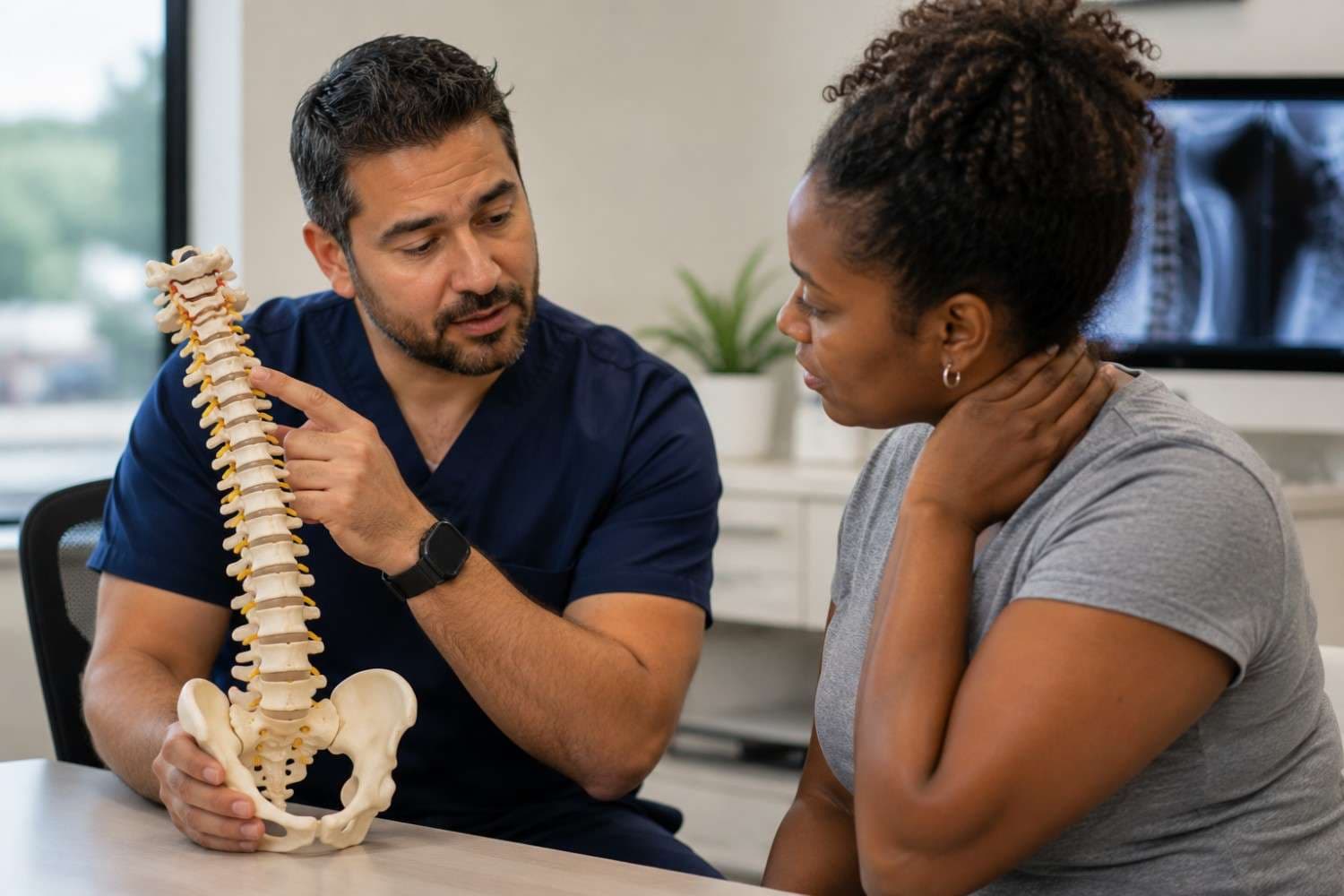
Understanding Different Types of Car Accident Impacts and Injuries
Driving through busy Beaumont TX—especially near intersections on Dowlen Road, along Interstate 10, or through the heavy traffic on College Street—means dealin…
Find Auto Injury Specialist Near You
Same-week appointments. Lien-friendly billing. Over 100 clinic locations across Beaumont and Houston.