
Exceptional Advanced Emergency Room Services in Beaumont
After a car accident, the emergency room is the right place to go when symptoms suggest a life-threatening or time-sensitive injury — chest pain, difficulty breathing, severe head injury, loss of consciousness, suspected fracture or spinal injury, or uncontrolled bleeding. For everything else, an urgent-care visit or a same-week appointment at our accident-focused clinic is often more appropriate and faster. This page helps you tell the difference and shows you what to do next.
Medically reviewed by Deepak Sharma, DC · Last reviewed · Updated
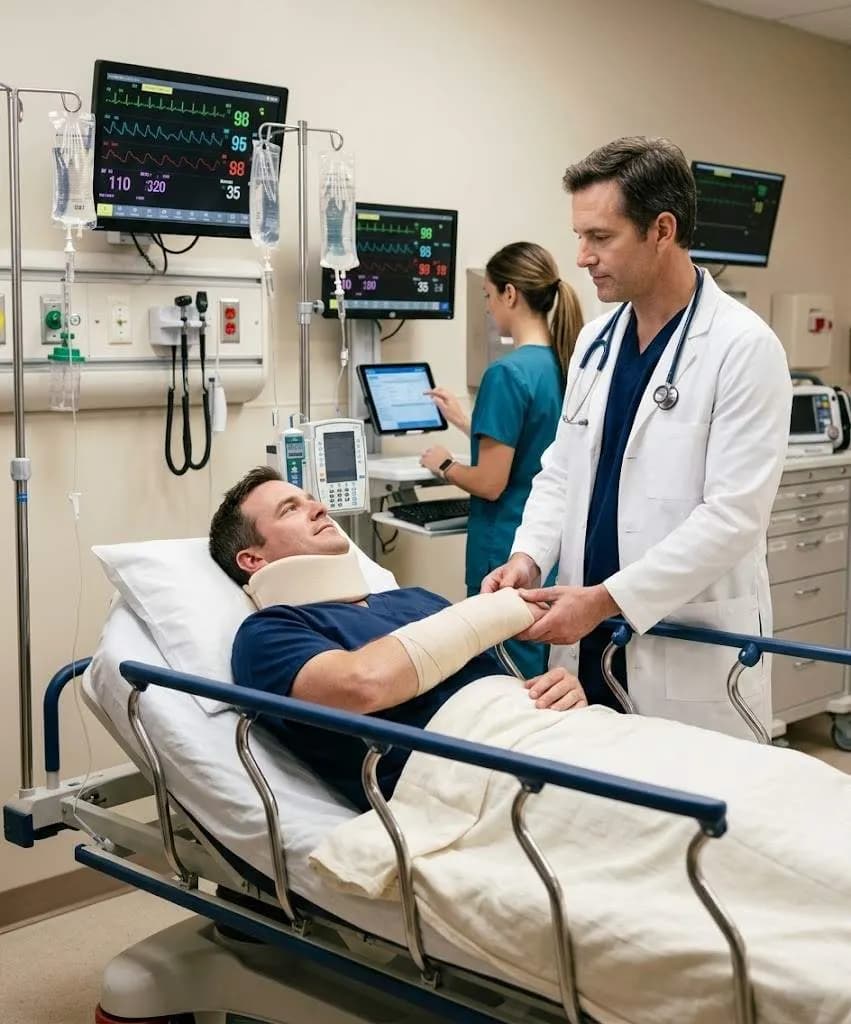
Quick answer · Key facts
- Call 911 or go to the nearest ER immediately for severe head injury, chest pain, breathing difficulty, loss of consciousness, suspected spine injury, or heavy bleeding.
- The American College of Emergency Physicians (ACEP) classifies any motor-vehicle collision with these symptoms as a true emergency.
- Urgent care or an accident-focused clinic is appropriate for moderate pain, stiffness, or whiplash with no red-flag symptoms.
- Even if the ER discharges you, a follow-up visit within 24–72 hours is strongly advised — delayed-onset symptoms are common.
- Save every ER record, scan, and discharge instruction; these documents matter for both your recovery and any claim.
- Medically reviewed by Deepak Sharma, DC.
When should you go to the ER after a car accident?
The emergency department exists for injuries that are life-threatening, function-threatening, or rapidly changing. After a crash, that means symptoms suggesting bleeding inside the chest or abdomen, a serious brain injury, a fracture, or damage to the spine.
According to the American College of Emergency Physicians (ACEP), the safest rule after any collision is: if you are unsure how serious it is, get evaluated — and if any red-flag symptom is present, do not wait.
Red-flag symptoms — go to the ER or call 911
Any of the following symptoms after a crash should be treated as an emergency. Call 911 or have someone drive you to the nearest emergency department immediately — do not drive yourself if symptoms are severe:
- Chest pain, pressure, or shortness of breath
- Severe head injury, loss of consciousness (even briefly), or worsening confusion
- Vomiting, severe headache, or seizure after a head impact
- Numbness, weakness, or paralysis in any limb, or any loss of bowel or bladder control
- Suspected fracture, visible deformity, or inability to bear weight
- Heavy or uncontrolled bleeding, large open wounds, or signs of shock (pale, clammy, fainting)
- Severe abdominal pain or rigid, tender belly — possible internal injury
- Severe neck pain with any neurological symptoms — possible spinal injury
If a spinal injury is suspected, do not move the person; call 911 and let EMS stabilize the neck and back before transport.
ER vs. urgent care vs. an accident-focused clinic — which is right?
Emergency room
For life-threatening or time-sensitive injuries: head trauma, suspected fracture or spine injury, chest pain, severe bleeding, breathing difficulty.
Urgent care
For moderate injuries with no red flags — sprains, minor lacerations, mild-to-moderate pain — when same-day care is needed and the ER is not warranted.
Accident-focused clinic
For ongoing whiplash, neck and back pain, soft-tissue injury, and follow-up after an ER visit — with imaging, chiropractic, and physician care under one roof.
Primary care
Reasonable for mild symptoms that develop later, though many primary clinics do not specialize in motor-vehicle injury or claim documentation.
Call 911
Whenever the situation is unstable, the patient cannot be safely moved, or red-flag symptoms are present at the scene.
Tele-triage
If you are unsure, calling a nurse line or our clinic for guidance can help you decide, but never delays care when red flags are present.
What to expect at the emergency room
Knowing the typical sequence reduces anxiety and helps you advocate for yourself or a loved one. Wait times depend on how busy the department is and how urgent each case is.
- 1
Triage
A nurse assesses your vital signs and the severity of your symptoms. The sickest patients are seen first, not the first to arrive. - 2
Registration & history
You provide insurance information (when possible) and a detailed account of the crash and your symptoms. Tell the team about any prior injuries or medications. - 3
Physical exam
An emergency physician examines your head, neck, chest, abdomen, back, and limbs for signs of injury. - 4
Imaging & labs
X-ray, CT, ultrasound, or blood tests may be ordered to look for fractures, bleeding, or internal injury. CT is often used for the head, chest, abdomen, or spine when trauma is significant. - 5
Treatment & decision
You are treated for what is found — pain control, wound care, splinting, or admission. Many patients are stabilized and discharged with instructions for follow-up. - 6
Discharge & follow-up
Take every paper they give you. Schedule the recommended follow-up within 24–72 hours, even if you feel better at discharge.
ER bills, insurance, PIP, and attorney liens
Emergency-department bills after a crash can be substantial. Texas auto policies often include Personal Injury Protection (PIP) or MedPay coverage that applies regardless of fault, and your health insurance also typically applies. Keep every itemized bill and explanation of benefits.
If you are pursuing a personal-injury claim and cannot afford follow-up care, we coordinate with attorneys on lien-friendly billing so post-ER care is not delayed by cost. We will explain options before any treatment begins.
Why follow-up within 72 hours matters
Many serious accident injuries — concussion, whiplash, internal bruising, disc and ligament injury — develop or worsen over the first 24 to 72 hours. Adrenaline at the scene masks pain, and the ER focuses on ruling out emergencies, not managing the next month of recovery.
A follow-up visit closes that gap. It catches delayed symptoms, gets imaging or rehab started, and builds the documentation that protects both your recovery and your claim.
Why patients trust Car Accident Cares for post-ER follow-up
We are not the emergency room — and after the ER is exactly where we are built to help.
Fast follow-up appointments
Imaging when it is needed
Coordinated specialty care
Documentation that supports your claim
Lien-friendly billing
Plain-language care plans
The emergency room rules out catastrophe. The next 72 hours decide how you recover.
Hear From Our Satisfied Clients
“The ER took care of the broken wrist and a possible concussion, but I left in a daze with no idea what to do next. Car Accident Cares got me in within 48 hours, did an MRI, and built a real recovery plan around the ER findings.”

“I thought I was fine after the wreck and skipped the ER. Two days later my headaches were unbearable. They evaluated me, ordered the right scans, and helped me organize all the paperwork for my attorney.”

Other ways we help recovery
Chiropractor Care in Beaumont
Spinal alignment, soft-tissue manipulation, and adjustment therapies to relieve back and neck pain after a collision.
Learn moreMD Consultation in Beaumont
Initial medical evaluation by a licensed primary-care MD to document injuries and coordinate downstream care.
Learn moreBest Affordable Beaumont MRI Diagnostic Imaging Service
High-field MRI for soft-tissue, disc, and ligament injuries — same-week appointments and transparent pricing.
Learn morePain Management Consultants in Beaumont
Non-surgical interventional pain specialists — trigger-point, epidural, facet joint, and medication management.
Learn moreCommon injuries we treat
Whiplash & Neck Pain Treatment
The #1 injury seen after rear-end collisions — even at low speeds.
See protocolHerniated Disc Doctor
Sciatica, radiating pain, and weakness from disc injuries.
See protocolLower Back & Knee Pain Treatment
Lumbar strain, ligament damage, and post-collision joint pain.
See protocolShoulder Injuries
Rotator cuff, labral tears, and seatbelt-related shoulder trauma.
See protocolFrequently Asked Questions About Emergency Room in Beaumont
Don't see your question? Call us at (409) 834-4100 — we answer 24/7.
Should I go to the ER after a minor car accident?
If you have no red-flag symptoms — no severe head injury, chest pain, breathing trouble, neurological symptoms, suspected fracture, or heavy bleeding — the ER is usually not necessary. Urgent care or a same-day appointment at an accident-focused clinic is often more appropriate. If anything about your condition is unclear or worsening, get evaluated.When should I call 911 instead of driving myself?
Call 911 whenever someone is unconscious, has trouble breathing, has chest pain, has a suspected neck or back injury, has heavy bleeding, or cannot be safely moved. Do not drive yourself if you have severe symptoms — let EMS stabilize and transport you.I feel fine at the scene. Could I still be injured?
Yes. Adrenaline routinely masks symptoms in the first hours after a crash. Concussion, whiplash, internal bruising, and disc injuries commonly worsen over the next one to three days. If symptoms develop, get evaluated promptly.What does the ER usually do for an accident patient?
Triage, history, physical exam, and — depending on the situation — X-ray, CT, ultrasound, or blood tests. Treatment focuses on stabilizing emergencies: bleeding, fractures, head and spine injury, and chest or abdominal trauma. Most stable patients are discharged with follow-up instructions.How long will I wait at the ER?
Wait times vary widely and depend on the severity of every patient in the department, not the order of arrival. The sickest patients are seen first. If your symptoms worsen while you wait, tell a nurse immediately.Do I need a follow-up if the ER said I was fine?
Almost always, yes. The ER's job is to rule out emergencies, not to manage the next weeks of soft-tissue recovery. Pain, stiffness, headaches, numbness, or memory issues that appear after discharge should be re-evaluated, ideally within 24 to 72 hours.How is the ER bill paid after a car accident?
In Texas, your auto insurance PIP or MedPay coverage typically pays first regardless of fault, then your health insurance. If liability is contested or you do not have coverage, an attorney lien may be an option for continued care after the ER. Keep every bill, EOB, and discharge paper.Should I see an attorney before or after the ER?
Get medical care first — always. After you are stable, speaking with a personal-injury attorney can help you understand documentation, insurance steps, and timelines. We coordinate with attorneys when patients ask us to.Can my child be evaluated at any ER after a crash?
Yes, but pediatric trauma is best handled at a hospital with pediatric capabilities when available. If the situation is urgent, go to the closest ER and EMS or the team there will arrange transfer if needed. Children can also mask symptoms — follow-up is important.What documentation should I keep from the ER visit?
Keep your discharge paperwork, itemized bill, every imaging report, lab result, and any prescription information. Note the time of arrival and the providers you saw. These records are essential for both your follow-up care and any insurance or attorney claim.
Deepak Sharma, DC is a licensed Doctor of Chiropractic and the owner of Car Accident Cares in Beaumont, TX. He reviews the clinical content published across the site and works with a multidisciplinary network of MDs, chiropractors, imaging centers, and pain-management specialists focused on accurate diagnosis, evidence-based treatment, and complete recovery for motor-vehicle-accident victims across Beaumont and Houston.
Explore Blog

What to Expect from Your Whiplash Recovery Timeline Texas After a Car Accident
Most whiplash patients recover within 6 to 12 weeks with appropriate care — but that window is not guaranteed, and for Beaumont drivers dealing with delayed sy…

Can a Car Accident Aggravate a Pre-Existing Condition in Texas?
If you have been involved in a motor vehicle collision in Southeast Texas, you likely have countless questions running through your mind. Assessing vehicle dam…
Understanding Different Types of Car Accident Impacts and Injuries
Driving through busy Beaumont TX—especially near intersections on Dowlen Road, along Interstate 10, or through the heavy traffic on College Street—means dealin…
Find Auto Injury Specialist Near You
Same-week appointments. Lien-friendly billing. Over 100 clinic locations across Beaumont and Houston.