
Pain Management Clinic in Beaumont, TX
A pain management clinic provides specialist care for the persistent or sub-acute pain that often follows a car accident — neck and back pain, radiating nerve pain, headaches, and joint pain that has not resolved with rest, medication, or initial therapy. The approach is multidisciplinary and opioid-conservative: targeted procedures, physical therapy, behavioral support, and careful medication use, organized around measurable functional goals rather than open-ended prescriptions.
Medically reviewed by Deepak Sharma, DC · Last reviewed · Updated

Quick answer · Key facts
- Pain management is a recognized medical specialty (often led by physicians board-certified in physical medicine and rehabilitation or anesthesiology).
- Care is multidisciplinary — combining medication, interventional procedures, physical therapy, and behavioral pain strategies.
- Treatment follows current CDC opioid prescribing guidance: non-opioid and non-pharmacologic options are prioritized whenever appropriate.
- Common interventional options include epidural steroid injections, facet joint injections, medial branch blocks, and trigger point injections.
- Goals are functional — sleeping, working, driving, parenting — not simply a number on the pain scale.
- Medically reviewed by Deepak Sharma, DC.
What does a pain management clinic actually do?
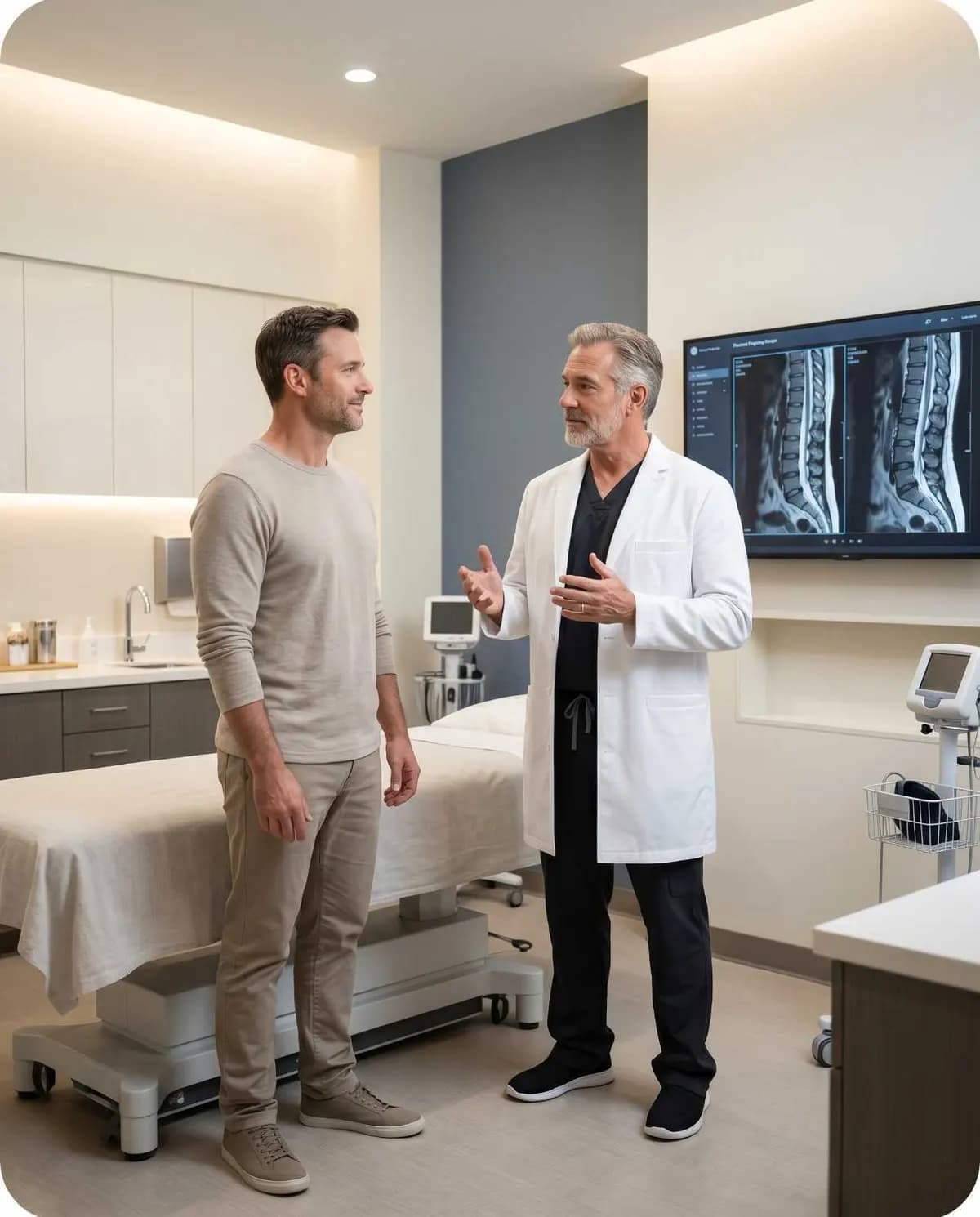
Pain management is the specialty that addresses pain when it persists beyond an initial injury — pain that is interfering with sleep, work, and daily function despite a reasonable course of conservative care. A pain physician's job is to identify the source, treat it precisely, and coordinate the rest of the team.
As organizations such as the American Academy of Physical Medicine & Rehabilitation emphasize, modern pain care is multidisciplinary — combining medication, targeted procedures, physical therapy, and behavioral strategies — rather than relying on any single tool.
When is pain management the right next step?
Pain management is typically appropriate when one or more of the following is true:
- Pain persists beyond four to six weeks despite appropriate conservative care
- Radiating arm or leg pain that suggests a nerve or disc source
- Headaches that interfere with sleep, work, or concentration
- Imaging shows facet joint, disc, or nerve involvement that may respond to targeted injection
- Medication needs are escalating, or current regimens are not controlling symptoms
- Function — work, driving, sleep, parenting — has not returned to where it should be
The point of pain care is function. Pain scores guide treatment, but getting your life back is the goal.
What does treatment look like?
Medication management
Non-opioid first — acetaminophen, NSAIDs, neuropathic agents, muscle relaxers — with opioids used briefly and conservatively when necessary, consistent with current CDC guidance.
Epidural steroid injection
Reduces inflammation around an irritated spinal nerve root; commonly used for radiculopathy from a herniated disc.
Facet joint injection
Targets the small joints of the spine when they are the pain source; can also be diagnostic.
Medial branch block & RFA
Numbs the nerves that supply a facet joint; if the block confirms the source, radiofrequency ablation can provide longer relief.
Trigger point injection
Targets persistent muscle knots that drive neck, mid-back, or shoulder pain after a crash.
Physical therapy referral
Active rehab is paired with every interventional plan — injections create a window, exercise keeps it open.
Behavioral pain strategies
Sleep, pacing, and stress strategies that meaningfully reduce pain perception and improve function.
Coordinated specialty input
Chiropractic, ortho, and imaging are integrated rather than separate — one plan, one team.
What to expect at your first pain management visit
Your first visit focuses on identifying the source of pain and building a written plan with measurable goals.
- 1
History & functional review
How the crash happened, where it hurts now, what makes it worse, and — importantly — what it is keeping you from doing. - 2
Focused exam
Neurologic screening, range of motion, joint and muscle testing, and provocative maneuvers to localize the pain source. - 3
Imaging review
X-ray, MRI, or other imaging is reviewed in context. Additional studies are ordered when targeted treatment depends on them. - 4
Diagnosis & plan
You leave with a clear diagnosis, an opioid-conservative medication strategy when needed, and a procedural and therapy plan if appropriate. - 5
Goal setting & re-evaluation
Functional goals are written down — return to work, sleep through the night, drive without pain — and a re-evaluation point is scheduled. - 6
Coordinated care
Physical therapy, chiropractic, or specialist visits are arranged so the plan moves forward as one.
Insurance, PIP, and lien arrangements for pain care
Pain management visits, injections, and related imaging are typically covered by health insurance and by Texas PIP or MedPay auto coverage when the care is related to a crash. We verify benefits before scheduling.
If you are uninsured or waiting on a settlement, ask about our lien-friendly arrangements with personal-injury attorneys. We will explain costs and options before any procedure is scheduled — there are no surprises.
Why the right time to escalate is not 'eventually'
Pain that lingers more than a few weeks beyond an accident does not always get better on its own — and the longer it persists, the more it changes how the nervous system processes pain. That phenomenon, sometimes called central sensitization, can make later treatment harder.
Escalating to pain management at the right moment — usually after a reasonable course of conservative care has not closed the gap — preserves your options and shortens recovery.
Why patients trust our pain management approach
Our team is built around accident recovery — precise procedures, conservative medication, and a coordinated team.
Opioid-conservative care
Image-guided procedures
Multidisciplinary by design
Functional goal setting
Documentation that supports your claim
Lien-friendly billing
Hear From Our Satisfied Clients
“After my crash I was on muscle relaxers for months with no real plan. The pain doctor here ordered the right imaging, did a precise epidural for my disc, and got me into PT. Within two months I was back at work full time.”

“I was worried I'd just be handed a prescription pad. Instead they walked me through a real plan — a targeted injection, therapy, and small changes I could actually keep. My headaches finally lifted.”

Other ways we help recovery
Chiropractor Care in Beaumont
Spinal alignment, soft-tissue manipulation, and adjustment therapies to relieve back and neck pain after a collision.
Learn moreMD Consultation in Beaumont
Initial medical evaluation by a licensed primary-care MD to document injuries and coordinate downstream care.
Learn moreBest Affordable Beaumont MRI Diagnostic Imaging Service
High-field MRI for soft-tissue, disc, and ligament injuries — same-week appointments and transparent pricing.
Learn moreOrthopedic and Spine Surgeon Consultation
Board-certified ortho and spine surgeons for fracture, ligament, and disc injuries that need a higher level of care.
Learn moreCommon injuries we treat
Whiplash & Neck Pain Treatment
The #1 injury seen after rear-end collisions — even at low speeds.
See protocolHerniated Disc Doctor
Sciatica, radiating pain, and weakness from disc injuries.
See protocolLower Back & Knee Pain Treatment
Lumbar strain, ligament damage, and post-collision joint pain.
See protocolShoulder Injuries
Rotator cuff, labral tears, and seatbelt-related shoulder trauma.
See protocolFrequently Asked Questions About Pain Management Consultants in Beaumont
Don't see your question? Call us at (409) 834-4100 — we answer 24/7.
When should I see a pain management specialist after a car accident?
A reasonable time to escalate is when pain has not meaningfully improved after four to six weeks of conservative care, when symptoms suggest a specific pain source (a herniated disc, an irritated facet joint, a trigger point), or when medications are not controlling symptoms and function is not returning.Will I be put on opioids?
Not by default. We follow current CDC guidance, which prioritizes non-opioid medications and non-pharmacologic care first. Opioids may be used briefly and conservatively in selected cases, with clear goals and a planned end. Long-term, escalating opioid therapy is not our approach.What is an epidural steroid injection?
A targeted injection of anti-inflammatory medication near an irritated spinal nerve root. It is commonly used for radiating arm or leg pain from a herniated disc. It is performed under image guidance, takes only minutes, and is intended to create a window for active rehab to work.Do injections hurt? How long do they last?
Most patients describe brief pressure rather than significant pain. Local anesthetic numbs the skin. Duration of relief varies — some patients feel improvement for weeks, others for months. Injections are paired with rehab so any window of relief is used.Are injections safe?
When performed by a trained pain physician under image guidance, the injections we use have a well-established safety record. Risks — bleeding, infection, temporary increase in pain — are uncommon. Your physician will review the specific risks for your procedure before consent.How is pain management different from chiropractic or physical therapy?
They complement each other. Chiropractic and physical therapy address joint motion, soft tissue, and movement patterns. Pain management adds physician-level diagnostic and interventional tools — injections, careful medication, and procedural options — when those are needed. At Car Accident Cares the services are coordinated rather than parallel.Will pain management cure my pain?
The honest answer is that some accident-related pain resolves completely, some becomes well-controlled, and some becomes chronic but manageable. Our goal is the best realistic recovery for your specific injury — measured by what you can do, not just by a number on a pain scale.Does insurance cover pain management?
Most health insurance plans cover pain management visits and standard procedures, and Texas PIP or MedPay auto coverage typically applies when the care is related to a crash. We verify benefits before scheduling and explain any out-of-pocket expectations up front.What if I do not have insurance?
We coordinate with personal-injury attorneys on lien-friendly billing so needed care can begin while a claim is pending. Costs and options are discussed before any procedure is scheduled.How quickly can I be seen?
Accident patients are prioritized, especially when severe pain or neurologic symptoms are present. Most consultations are scheduled within the same week, and many procedures can follow shortly after when indicated.
Deepak Sharma, DC is a licensed Doctor of Chiropractic and the owner of Car Accident Cares in Beaumont, TX. He reviews the clinical content published across the site and works with a multidisciplinary network of MDs, chiropractors, imaging centers, and pain-management specialists focused on accurate diagnosis, evidence-based treatment, and complete recovery for motor-vehicle-accident victims across Beaumont and Houston.
Explore Blog

What to Expect from Your Whiplash Recovery Timeline Texas After a Car Accident
Most whiplash patients recover within 6 to 12 weeks with appropriate care — but that window is not guaranteed, and for Beaumont drivers dealing with delayed sy…

Can a Car Accident Aggravate a Pre-Existing Condition in Texas?
If you have been involved in a motor vehicle collision in Southeast Texas, you likely have countless questions running through your mind. Assessing vehicle dam…
Understanding Different Types of Car Accident Impacts and Injuries
Driving through busy Beaumont TX—especially near intersections on Dowlen Road, along Interstate 10, or through the heavy traffic on College Street—means dealin…
Find Auto Injury Specialist Near You
Same-week appointments. Lien-friendly billing. Over 100 clinic locations across Beaumont and Houston.