Owner & Doctor of Chiropractic · 14 min read · Published · Updated · Last reviewed
Picture this familiar Beaumont scenario: You are backing out of a busy grocery store parking lot or sitting at a red light on Dowlen Road when another driver bumps into your rear bumper. It is a minor fender bender. You get out, inspect the minimal damage—maybe a small dent or some scratched paint—exchange insurance info, and head home. At the scene, you feel completely fine. But a few days later, you notice a sharp, shooting pain down your leg or a strange numbness while sitting at your desk.
You might think you just slept wrong, but identifying the signs of herniated disc low impact collision early is incredibly important. That “no big deal” tap can hide a serious disc injury—your body signals it’s time for a check. Many survivors dismiss minor crashes, completely unaware that the physical forces involved can severely impact their spinal health. In fact, disc injuries are shockingly common in rear-end collisions due to sudden flexion-extension forces, even when there is absolutely zero vehicle damage.
Why Low-Impact Collisions Can Aggravate Disc Injuries
One of the most persistent myths surrounding auto accidents is the belief that if your car is not badly damaged, your body must be unharmed. Modern vehicles are engineered with stiff bumpers designed to withstand low-speed impacts (under 10 mph) without crumbling. Because the car does not absorb the crash energy by crushing, that kinetic energy is transferred directly into the cabin — and into your body.
When your vehicle is struck from behind, your body is thrust forward while your head remains momentarily stationary, creating a violent “whip” motion in your cervical and lumbar spine. This rapid, S-shaped flexion and extension puts immense pressure on your spinal column. The spine is made up of interlocking bones (vertebrae) cushioned by rubbery, gel-filled discs. The sudden shearing forces of a low-impact crash can squeeze or irritate the outer layer of these discs — and if you had any pre-existing, asymptomatic degeneration, even a minor collision may be enough to trigger a herniation.
It is important to understand: research indicates that acute herniations in an otherwise healthy spine from very low-speed impacts are rare. However, a significant percentage of adults have pre-existing disc degeneration they are completely unaware of, and a collision — even a minor one — can be the catalyst that turns a silent, asymptomatic condition into a painful, active injury. This is why a thorough medical examination immediately after any collision is essential, regardless of crash severity.
The 7 Key Signs of Herniated Disc Low Impact Collision
If you have been in a minor crash, your body will eventually tell you if something is wrong. Because the spinal cord serves as the main information highway for your entire nervous system, a pinched nerve from a herniated disc will send warning signals to various parts of your body. Here are the most critical signs to watch for:
1. Radiating pain (sciatica) down your leg or arm
A classic symptom of a herniated disc in the lower back is radiating leg pain post-accident that shoots through your buttocks and down the back of one leg, often extending past the knee. If the herniation is in your neck, you will likely feel this radiating pain traveling down your shoulder and arm, sometimes reaching past your elbow. A Beaumont auto injury chiropractor can test nerve conduction patterns to confirm whether this radiating pain originates from a compressed disc.
2. Numbness or tingling ("pins and needles")
When the jelly-like center of a disc pushes against a nerve root, it disrupts sensory signals. This often manifests as a “pins and needles” sensation. You might experience unexplained numbness in your foot, calf, hand, or fingers, making it feel like your limb has “fallen asleep” and will not wake up.
3. Muscle weakness, foot drop, or grip issues
Motor nerves control your muscles. If a herniated disc compresses these specific nerves, you may suddenly find yourself stumbling because you cannot lift the front part of your foot — a condition known as foot drop. In the upper body, this can present as a weakened grip, making it difficult to hold your phone or a cup of coffee.
4. Pain that worsens when sitting, bending, coughing, or sneezing
A herniated disc is highly sensitive to pressure changes in your spinal column. Sitting down, hunching forward, or even the sudden internal pressure caused by coughing or sneezing can cause a sharp spike in your pain levels as the disc is pushed further against the nerve.
5. Deep lower back or neck ache and stiffness
While radiating pain is common, localized pain is also a major red flag. You may feel a deep, throbbing ache in the exact location of the injury, accompanied by severe muscle stiffness. Your body naturally tenses the surrounding muscles to protect the injured spinal segment.
6. Burning or sharp pain from your back to your buttock
Unlike a dull muscle ache, nerve pain caused by a herniated disc is often described as electric, sharp, or burning. This intense, fiery sensation usually starts in the lower lumbar region and shoots directly into one of your buttocks.
7. Reduced or altered reflexes
Though harder to notice without a medical exam, a compressed nerve can slow down your body’s natural reflex responses. If you feel exceptionally clumsy or notice that your knee or ankle doesn’t respond as quickly as it normally would, it is time to seek professional evaluation.
Bulging disc vs. herniated disc symptoms after minor crash
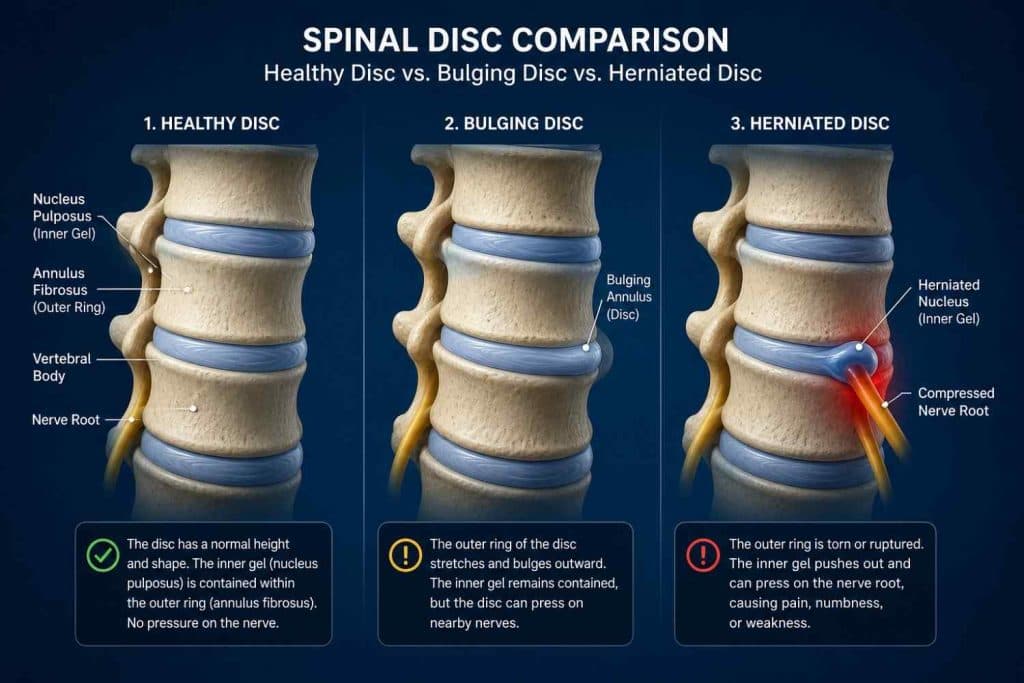
While researching your symptoms, you might see the terms “bulging disc” and “herniated disc” used interchangeably, but medically, they represent two different stages of spinal trauma. Understanding bulging disc vs herniated disc symptoms is essential for getting the right diagnosis and treatment plan.
Think of your spinal disc like a jelly doughnut. The tough, rubbery exterior is the annulus fibrosus, and the soft, jelly-like center is the nucleus pulposus.
What is a bulging disc?
A bulging disc occurs when the tough outer layer remains intact but is stretched or flattened out under pressure, causing the disc to bulge outward slightly. In contrast, symptoms of a bulging disc are often localized to the back or neck, causing a dull ache and stiffness rather than severe radiating pain. Many people live with asymptomatic bulging discs until a crash aggravates them.
What is a herniated disc?
A herniated disc, on the other hand, is a rupture. The violent forces of a car crash cause the tough outer layer to tear completely, allowing the inner jelly to leak out into the spinal canal. This inner gel contains inflammatory proteins that severely irritate the spinal nerves. Herniated discs are therefore much more likely to cause the intense, radiating symptoms like sciatica, numbness, and severe muscle weakness. Both conditions can easily result from low-speed impacts, but herniated discs generally require a more targeted, specialized treatment plan from a trustedherniated disc doctor. For more clinical insights on disc variations, reputable resources like theMayo Clinic provide extensive anatomical details.
Why symptoms often appear days later — and what to do
It is incredibly common to walk away from a low-impact collision feeling fine, only to find yourself in excruciating pain 48 to 72 hours later. This delay is heavily influenced by your body’s survival mechanisms and the natural healing timeline of soft tissues.
When you are involved in an accident, your adrenal glands flood your system with adrenaline and endorphins. This “fight or flight” response acts as a powerful, temporary painkiller. Furthermore, the trauma to your spinal discs and surrounding tissues triggers a slow-building inflammatory cascade. It can take two to seven days for the swelling to build up enough to physically compress a nerve root and trigger pain signals. To learn more about how these forces affect your body, reading up on soft tissue injuries is highly recommended.
The most important step you can take is not to wait. Hoping the pain will simply fade away often leads to acute injuries turning into chronic, lifelong conditions. Medical research hosted by the National Institutes of Health (NIH) consistently shows that early intervention prevents permanent nerve damage.
⚠️ Important Red Flag: If you ever experience a sudden loss of bowel or bladder control, or severe numbness in your saddle area (inner thighs and groin) following a crash, this is a medical emergency known as Cauda Equina Syndrome and requires immediate hospital care.
What a disc injury evaluation includes at Car Accident Cares
If you are experiencing any of these delayed symptoms, getting a professional evaluation is your most vital next step. At Car Accident Cares, we do not dismiss your pain just because your car lacks major damage. We treat the patient, not the bumper.
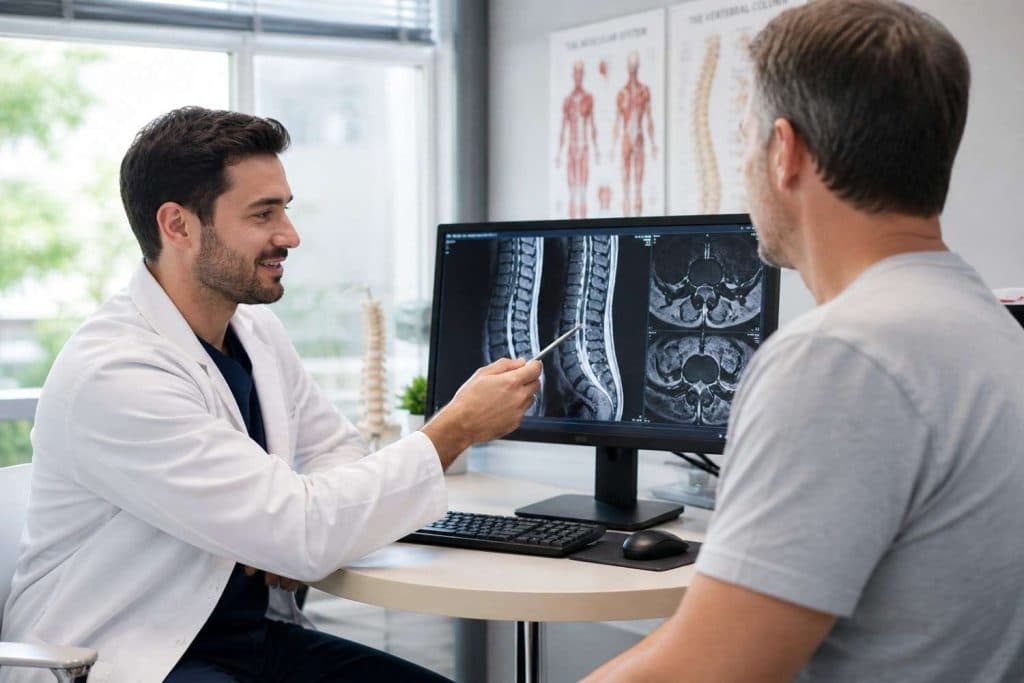
Your evaluation begins with a comprehensive physical exam by a medical doctor who will test your reflexes, muscle strength, sensory responses, and range of motion. Because X-rays only show bone and cannot see soft tissue like spinal discs, we provide same-day referrals forfast imaging results like MRI for disc injury. An MRI or CT scan is the only definitive way to properly visualize a herniated disc and pinpoint exactly which nerve is being pinched.
Once we have a clear picture of your injury, our multidisciplinary team collaborates on a customized treatment plan. This may seamlessly integrate advancedwhiplash and neck pain treatment, gentle chiropractic care, and specialized pain management for radiating disc pain. We also handle all the complex PIP and auto insurance paperwork, and can even provide transportation assistance so there are absolutely zero barriers to you getting the care you deserve.
Get Signs of Herniated Disc Low Impact Collision Evaluated — Same-Day in Beaumont
Your health is far too important to leave to chance. If you have been in a fender bender and are waking up with mysterious numbness, tingling, or shooting pain, those are clear indicators that your spine needs attention. We understand how stressful the post-accident window can be, which is why we focus on compassionate, comprehensive care under one roof.
Do not let a “minor” crash cause a major disruption to your quality of life. Discover the reasons to visit a chiropractor after an auto accident and take control of your recovery today.
Frequently Asked Questions About Car Accident Care in Beaumont
Can a low-impact car crash really cause a herniated disc?+
In many cases, yes — particularly if you had pre-existing disc degeneration, which is extremely common and often asymptomatic. The sudden transfer of kinetic energy forces your spine into an unnatural flexion-extension motion. This whipping motion can aggravate or rupture a disc that was already under stress, even if your car shows no damage.
Why didn't my back hurt immediately after the fender bender?+
Right after an accident, your body releases adrenaline and endorphins, which temporarily mask pain. Additionally, soft tissue swelling and inflammation can take 48 to 72 hours to build up enough to compress a spinal nerve and trigger noticeable pain. This delayed back pain after fender bender is very common and should not be ignored.
What does nerve pain from a herniated disc feel like?+
Nerve pain is usually described as a sharp, electrical, or burning sensation that shoots down an arm or a leg. It is often accompanied by numbness, a “pins and needles” feeling, and muscle weakness in the affected limb.
Is a bulging disc the same as a herniated disc?+
No. A bulging disc means the tough outer layer of the disc is stretched outward but remains intact. A herniated disc means the outer layer has completely ruptured, allowing the inner gel to leak out and irritate the nearby spinal nerves. Both require professional evaluation.
How long should I wait to see a doctor if I only have minor back stiffness?+
You should not wait. It is highly recommended to seek a medical evaluation within the first 72 hours after any car accident. Early diagnosis prevents minor inflammation from turning into chronic, debilitating nerve damage.
Will an X-ray show if I have a herniated disc from my crash?+
No. Standard X-rays are excellent for detecting bone fractures, but they cannot see soft tissues like spinal discs, muscles, or nerves. An MRI for disc injury after crash is the most accurate imaging test used to properly diagnose a herniated disc.
Why does my leg go numb when I sit down at my desk after my accident?+
Sitting puts significantly more mechanical pressure on the lower lumbar discs than standing does. If you suffered a herniated or aggravated disc in a crash, sitting compresses the disc further against your sciatic nerve, triggering leg numbness and pain.
Can physical therapy and chiropractic care fix a herniated disc?+
Yes, in many cases. Non-surgical treatments like targeted spinal adjustments from a Beaumont auto injury chiropractor, physical rehabilitation, and pain management injections can relieve nerve pressure, reduce inflammation, and help the disc heal naturally over time.
Will my auto insurance cover my treatment for a low-impact crash injury?+
In most cases, yes. Personal Injury Protection (PIP) or the at-fault driver’s insurance is generally responsible for your medical bills related to the accident, regardless of how minor the vehicle damage was. We assist with all required documentation.
What should I do if my pain keeps getting worse days after the collision?+
If your pain is worsening, or if you develop sudden muscle weakness, foot drop, or severe numbness, you need an immediate medical evaluation. Book a same-day appointment for an exam and an MRI referral to accurately diagnose the signs of herniated disc low impact collision and get the right care fast.
Medically reviewed by
Verified
DS
Deepak Sharma
DC
Owner & Doctor of Chiropractic
Deepak Sharma, DC is a licensed Doctor of Chiropractic and the owner of Car Accident Cares in Beaumont, TX. He reviews the clinical content published across the site and works with a multidisciplinary network of MDs, chiropractors, imaging centers, and pain-management specialists focused on accurate diagnosis, evidence-based treatment, and complete recovery for motor-vehicle-accident victims across Beaumont and Houston.